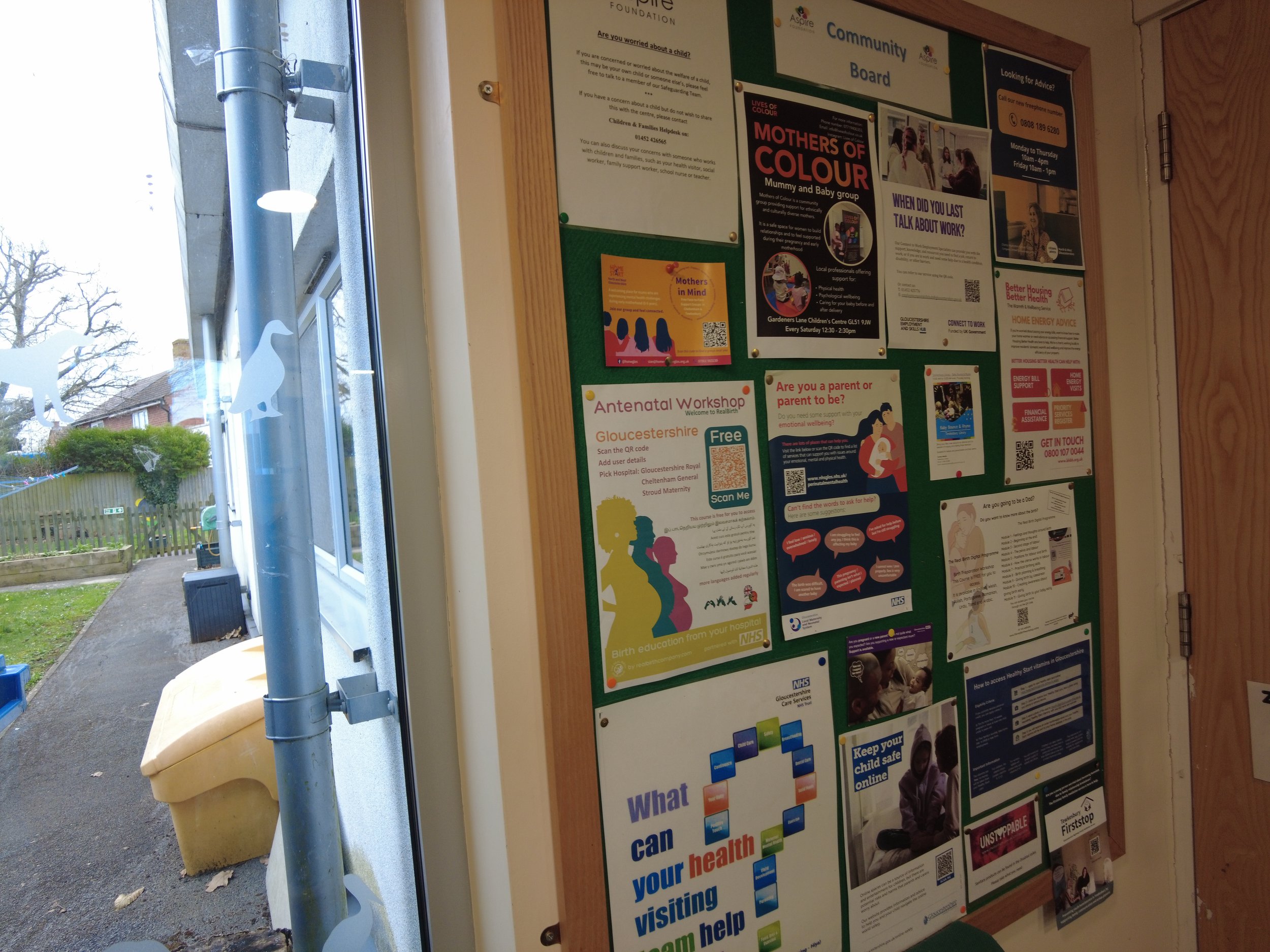
On Thursday 26th February I attended the fifth session of our Priors Park place workshops. This week saw the community church joint hosting with Noah’s Ark Children & Family Centre; ran by the Aspire Foundation not even a 5-minute walk up the road. This week saw a slightly smaller group than normal but excitingly we were joined by a couple of long-time residents who were keen to learn what the session was all about and give their views. Rich was also accompanied once again by the wonderful Emily Brady-Young.
In this session we were tackling two main questions:
Now that we’ve agreed on the core message and objectives of Priors Park’s ‘place plan’, what actions can we begin to take and how?
What have we learnt so far and how is it working to change the way we interact, build relationships and share understanding?
This week we started with small story sharing activity in pairs focusing on when in our life, we’ve seen positive change and how it resonated with us. This of course helped to break the ice for anyone new but also helped to establish where we were all at right at the beginning of the session, doing a good job at highlighting what we each hold value in and what drives us to do the work we do. I spoke a little with Ben Thompson in this time, one of our investment managers. He has been dipping in and out of Priors Park for a while, more specifically tied to the demolition of the garages in collaboration with Create Streets, which is happening very soon!
He shared with me how we viewed Place from an investment perspective and ultimately it all came down to how the corporate structure around investment would change to accommodate place-based working. This is something that has been discussed before, but it is proving to be a difficult question to answer at this stage in the process, mainly due to scale. Which is understandable, as investment is one of those branches of work that must think about the whole before making a decision, especially regarding policy and regulation. However, without place, the work around the garages in Priors Park would never have come to fruition so in truth we are seeing two sides of the same coin. I would love to see the discussion on this go further and perhaps see some more experiments to test to waters of investment in place.
Before being split off into two groups we were told to take a colour coded sticker and plot on a small timeline when we first attended these sessions, along with our name and job role. This may seem like a very simple task, but this will be used later down the line to collate how the landscape of the sessions has changed over time.
Group Work
Rich’s Group – Stayed at the community church to explore what actions we can begin to take and come up with creative ways to execute them.
Emily’s Group – Went over to Noah’s Ark to discuss learnings so far.
These two groups would swap over in the PM.
Emily's Group
Resident’s Stories
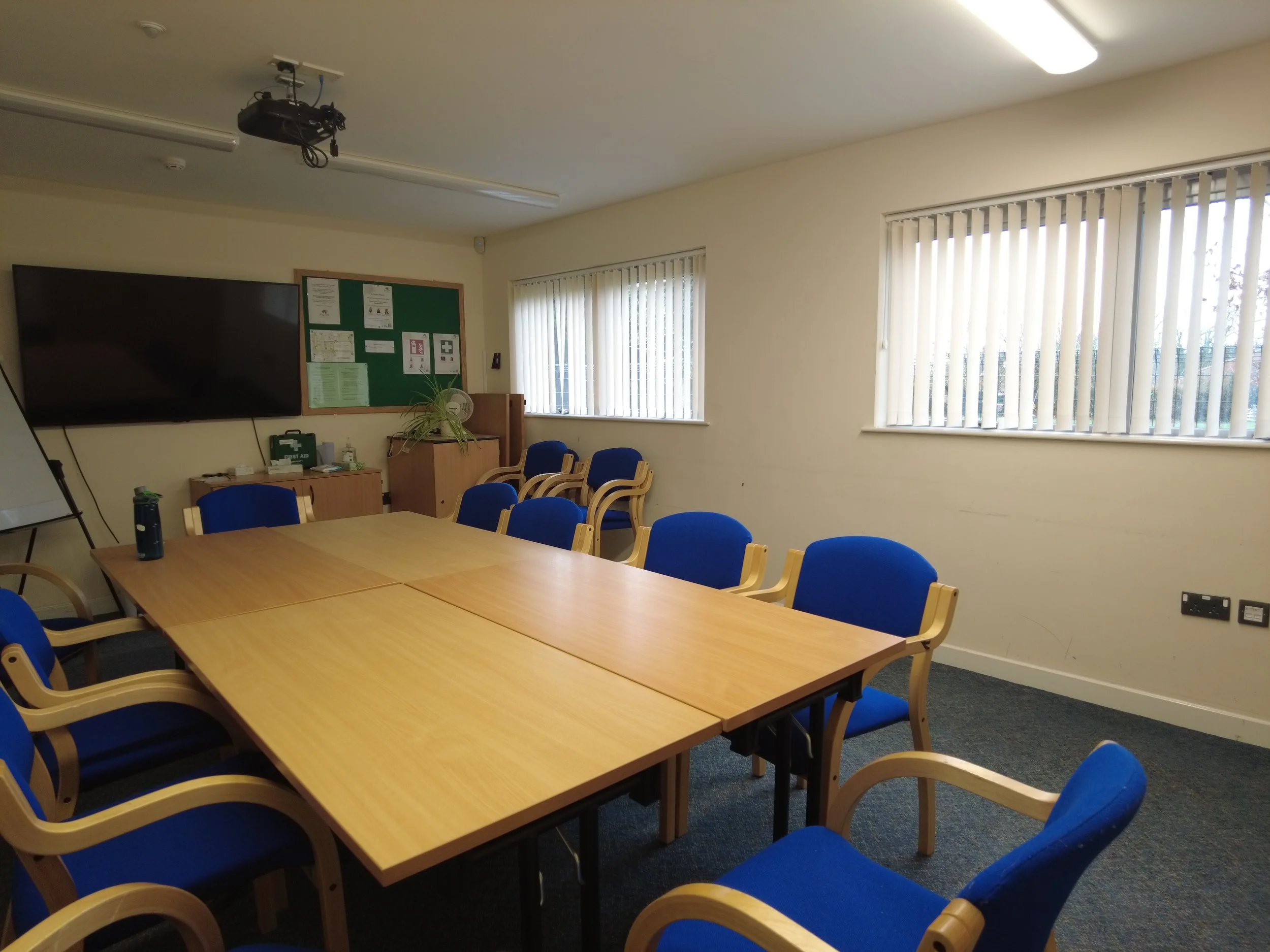
In the morning, I was a part of Emily’s group on the basis that I was interested in the reputation and storytelling aspect of this entire project. I was joined by a unique array of people from the group, each with their own stories, as well as ambitions for what can and needs happen in Priors Park. The highlight of the session for me was a man who’d joined the session as a long-time resident (not a BFL customer) and community member. He explained that he was a retried social worker from Birmingham and had moved to Priors Park since. He started off by saying that “There has to be passion and love for the area.” which everyone else in the room immediately echoed. He went on to tell us anecdotes about work he’s done within the community, most notably;
The installation of the chemist – which was just down the road from where we were. He explained it was something everyone in the community wanted for a while and he’d managed to be part of getting it delivered.
Campaign for the nature reserve – had managed to get interest and eventually a petition for it started up in the local pubs and it took off from there.
Advocacy for access – had had a few petitions rejected to improve the access residents had to their homes in Priors Park and as a result decided to get the local Fire and Ambulance crews involved on the grounds of them not having good access either which posed a huge safety risk. This alone managed to push it through and speed up its delivery. The left-over money from this got put back into the community garden.
He’s Santa! - To all our surprise we learnt that he is one behind the Santa that goes through Priors Park every year. It’s like a small tradition for the area and another resident in the room even recalled her child chasing him down the street the year before.
Four incredibly powerful examples that left me in awe of his passion and dedication to his community and those around him. When asked about what motivated him, he simply answered that “These are real people and this is their home.” and “It’s about mutual respect.” He applied this same thinking to BFL and said that in his view with our “backup” a lot more stuff like this could happen and he’s right. He’s making the important point that we don’t always have to be providing a service; that sometimes all is needed is our support, using our influence where it matters to almost boost the community in the algorithm.
Something similar was described by another resident in our group. She told us that she initially baked cakes to encourage people to help her clean up the community garden, but how that naturally developed into community litter picking. There was a shared feeling that “fly tipping is everyone's problem” and it was tackled as such. She shared a lot with us, most of which I won’t go to deep into here as a lot of it was highly personal, but the key thing that stood out was her deep familial ties to Priors Park. She told us how her surname is a widely known one in the area, how her parents, herself and now her daughter have all grown up here, that when she moved out of Priors Park, she hated it because “no one spoke to each other, everyone just kept themselves to themselves.” What was most notable was how distinct the language used around Priors Park is; like how locals just call it “The Park” and how at school you’ll get called a “Parkey”. In other words – a strong sense of identity.
BFL's Role
Now that we’d explored some stories, the middle part of the conversation seemed to centre around the role of leadership in all of this and BFL was used as the main example.
The first and most important sentiment the group shared was that BFL’s involvement is categorically helping, without a shadow of a doubt. Many said that they felt that this type of workshop would never have got off the ground if BFL hadn’t done the work to get it on its feet and without BFL’s name tied to it, many of the other perhaps bigger participants like Travis Perkins and the local council would have passed over it. BFL’s involvement has also inspired many who are part of the workshops to feel like this work is actually going to lead somewhere and multiple people in the group shared that they were pleasantly surprised by the attitudes of the BFL staff involved, saying it “feels more down to earth” and that “they really care”.
However, this feedback then leads onto the question of how we can keep that energy going; which is where the bugbears start to raise their heads. The ones raised below are just a few I picked up throughout the session;
Policy & regulations lock us away - makes everything feel very aloof and “unreachable”, promotes a “lack mindset” as you “prepare for rejection”, “firefighting mentality”
Questions this created > Do we need to be more stubborn against poor policy? Do we need to be more creative in how we deal with roadblocks? Do we need to look for alternative routes or backdoors to get the outcomes we need and know customers deserve?
Lack of understanding/interest from leadership – settled on the notion that it constricts forward movement, work like this stops before it even starts in favour of “business as usual”, colleagues often lack the “breathing room” away from “day to day operations” to get involved, mention of “conflicting priorities”, merger has put more pressure on this, bit of a snake eating it’s only tail moment.
Questions this created > Do we need to set aside time for project work and start quantifying it? (discussed a story of how one person quantifying their time doubled the money they got in a grant), Is a place lead the missing component or do colleagues just need "permission"? How can managers/leaders be more supportive?
We overcomplicate things – we overcomplicate what should be very straightforward issues and we expect customers to understand those self imposed complexities, customers are “very rarely told what's truly going on”, we tend to be defensive over our processes even though we are categorically being told it doesn’t work, leads to customers not feeling heard, we give “blanket no’s with zero explanation”, decision making isn’t being done on a “customer value” basis.
Questions this created > Do we need to start “throwing around our weight more”?, Do customers recognise our influence more than we do? How can we start truly co-creating? Are we thinking through the lens of “mutual exchange” and “respect”? Why do we say no if we don't have an alternative to offer?
Shooting the messenger - Customers reach out when they “spy their chance” as reaching us is difficult, in most cases the person who is easiest to reach in any given moment is the NC meaning they then “take the brunt of the criticism” for failures outside of their control, often during face to face meetings.
Questions this created > How do Neighbourhood Coaches think we can improve our customer relations seeing as they are some of the colleagues who spend the most time out in communities? How many office-based colleagues that deal with issues outside of the areas they effect are customer facing? How many leaders making decisions for areas are customer facing?
No one enjoys discussing the bugbears, but they need to be thought about in order to continue to inspire movement in the right direction and the questions raised can spark further discussion. Emily Brady-Young is keen to record and analyse these discussions as part of her own work to map out what this process looks like from a human perspective and potentially go as far as to create a forward vision of how this will develop based purely on behaviours, thoughts and actions we are currently taking. Real invaluable stuff.
Some positive takeaways:
This is now on a larger scale than just a community group – more and larger orgs are getting involved now which makes it feel more real and “tangible”.
There is more commitment – there's a tightly knit group behind this project now, that will keep it's momentum going through their connection
Community bingo – learning everyone has strengths/something to give
Place has provided connection outside of the corporate structure – if we live/work in the same place, might as well do it together
Place teams working well – Priors Park feel they are “missing the role of a place lead” to unlock extra capacity from what they've observed elsewhere in the business
Familiarity is highly valued – seeing the same faces leads to more accountability, more responsibility, a better view of everything that's going on, an easier time building relationships and allows place teams to be proud of their colleagues and area.
Rich's Group
When we swapped over to join Rich back at the community church we were first informed of what the other group had discussed in terms of action. They’d thought of creating some form of heatmap to locate areas of interest within Priors Park and identify catalysts of movement for people. This would work in a sort of tandem with the previously discussed asset maps, which Rich was also trying to come up with a way to visualise.
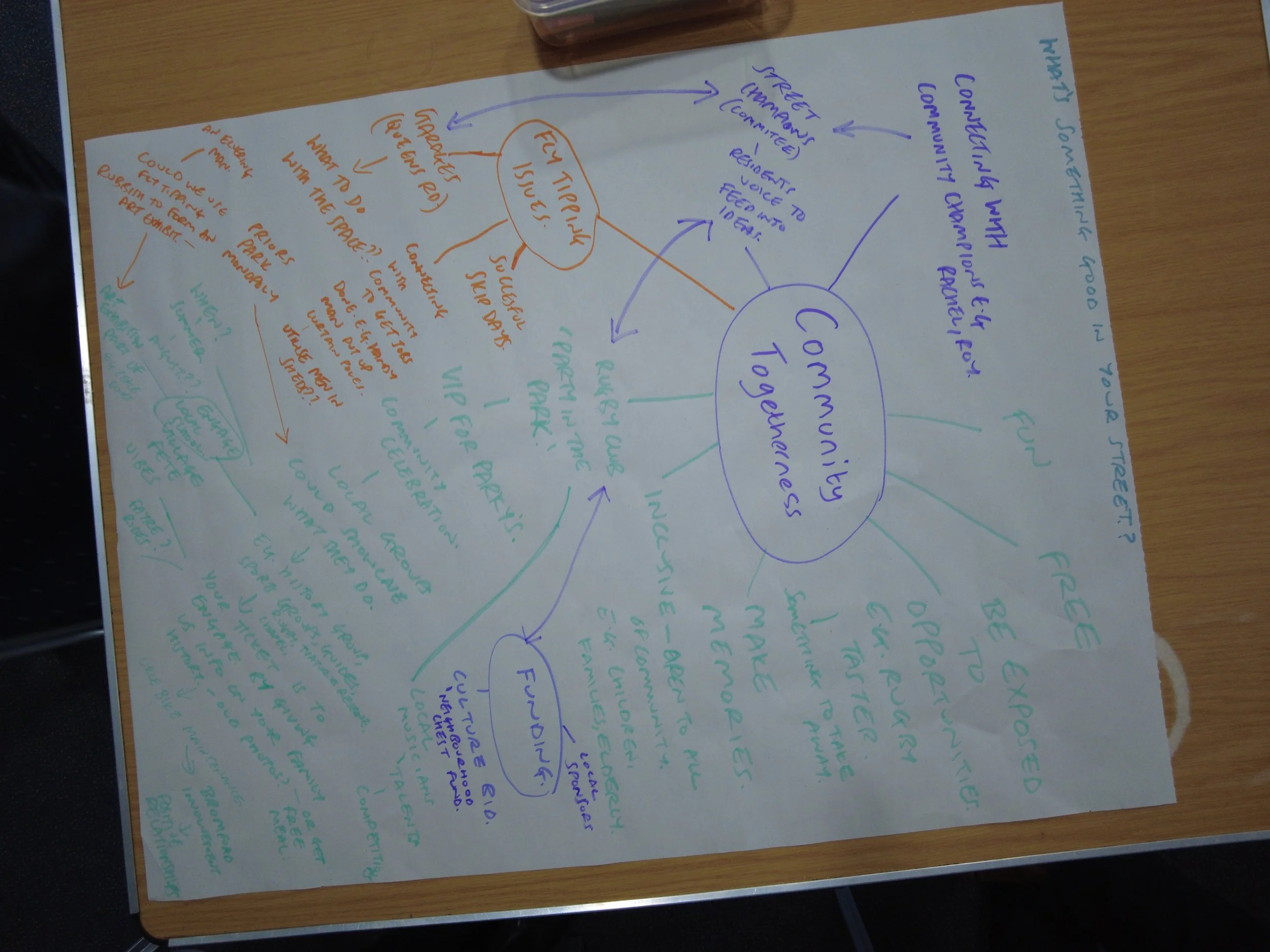
Our group started off with a chat about This Is Tewkesbury, a yearly community day held in town showcasing local groups in art, sport, health, heritage, and more. It was agreed from those familiar with the event that it could feel a little corporate at times due to its location and the way it's set up. To combat this, a member of the group from Tewkesbury RFC, proposed a community event held in Priors Park, using his own venue; the Rugby Club. He went on to say how it would be a good opportunity to give something back to community whilst also asking for feedback, potentially swapping it or stories in a submissions box in return for free entry or food vouchers at the event. This perfectly echoed the discussion around mutual exchange back at Noah’s Ark. We all then started chipping into this idea, outlining more of what the event itself could look like as well as what we’d need to make it come to fruition.
The event’s working title is “Party In The Park” and aims to be an event where people from every corner of the area can connect. We discussed everything things like what activities would be there, what food would be there, a timeline for organising it etc. Someone else came up with the idea of creating an art piece from rubbish in the area like other community projects have done online or even creating an asset map that looks like a “Priors Park monopoly board”; something that everyone could understand and contribute to. On the surface it may just seem like a “run of the mill community event” but this is an event created predominantly by the people who live there, using their own strengths and resources to do it, with shared aims to collect information on what their community want to see going forward.
Overall, the outlook is looking very positive in terms of having something tangible and long-term come from these sessions that have the backing of everyone involved. Yes, it doesn’t quite echo a “place plan” yet but it does show that the people of Priors Park want to share their views, want to help us be better and are on board with the place vision because they finally feel like they have some agency.
It's our last official session together next month so now is a better time than ever to express your thoughts on this work and ask your questions.
Watch this space.