
It’s been a while since I’ve attended a Disruptive Innovators Network event in person, so I was very thrilled to be able travel to London to attend the autumn network meeting!
The event was being held at the Salesforce tower, and WOW, was that a quick lift ride up to the 36th floor!
The one thing I love about DIN events is having the opportunity to speak to people from other organisations, to see what they are up too, hear some of their barriers and bug bears they are facing and even talking about family and life in general.
We spent the day on the Ohana floor, and as a secret Lilo and Stitch fan (well not now because I’ve told you), you would know Ohana means family and you certainly get that feeling, with spectacular views of the Thames, overlooking Finsburys circus gardens and a stone’s throw away from the Gherkin.
It was a perfect setting for an inspirational pioneering day.
After grabbing a quick cuppa and claiming my seat near the front (such a swot), Ian opened the event and reminded us why we were there. Ian likes to bring to life some key themes for the day and one that stuck out to me was…
“If you are not failing to be better, you’re not doing your job”
The first speaker was Susie Braam. Susie was fantastic! Susie discussed some of the barriers that was faced with innovation whilst working at the MOD, amongst other places in the national security arena. Some of the things Susie spoke about really resonated with me and some of the struggles we face. Here are a few of my take aways!
· Siloes and territory – Working in siloes and being overly protective of problems are some of the biggest barriers to innovation. It means lack of collaboration, the ability to move resource and it stops you from taking advantage of immerging opportunities.
· Deep systems – Things like HR, legal, commercial, compliance can stall innovation. They can cause friction as they are designed for core business and not for innovation. At what pace can you test organisational ideas? How easy is it for us to create new policies and processes or adapt existing ones? By upsetting the status quo, it can leaves a lack of risk appetite.
· Lack of education and awareness around Innovation – If you want to be a Future focused organisation but aren’t training your leaders to lead innovation then we are doing something fundamentally wrong. We should be educating our organisations to understand innovation and where do they fit into the design process. Do our leaders promote a culture of creativity and exploration? And to what extent do our leaders demonstrate curiosity themselves and encourage curiosity in others?
· Diversity and inclusion - are essential to innovation. Without it, we don’t hear different voices and perspectives - whether they are the voices and perspectives of our customers and partners or of other people in our organisations.
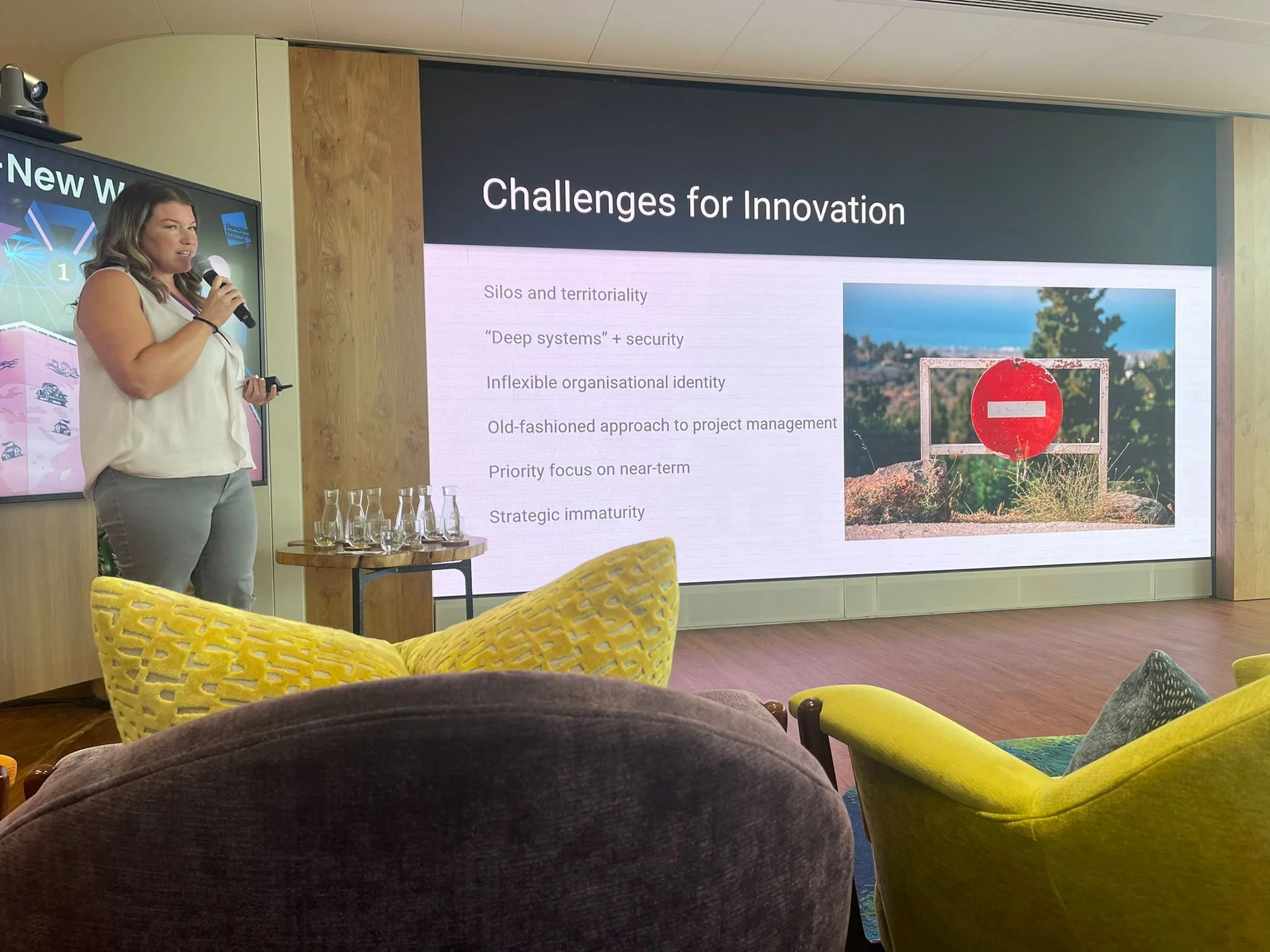
· Measure – Always find things to measure, as even imperfect metrics give you a baseline and lets you know you are moving in the right direction.
· Innovation Skills – Organisations need to understand the skill sets within innovation and service design. Not everyone needs to be innovating across the business, it would cause utter chaos. However, everyone would benefit from understanding what Innovation is. Do you have dedicated and protected people whose job is to focus on innovation?
· Changing mindsets – moving away from ‘we’ve tried that once’. Instead, we should be thinking, what did we learn form that, lets revisit and adapt.
· Innovation should be a part of the corporate strategy – If you aren’t thinking about what’s the future of this organisation, then you aren’t really thinking about the future.
Next up we heard from Chris Marsh who talking about digital transformation. Chris talked about how it’s the right time for any organisation to pause and reflect on CX, society and tech.
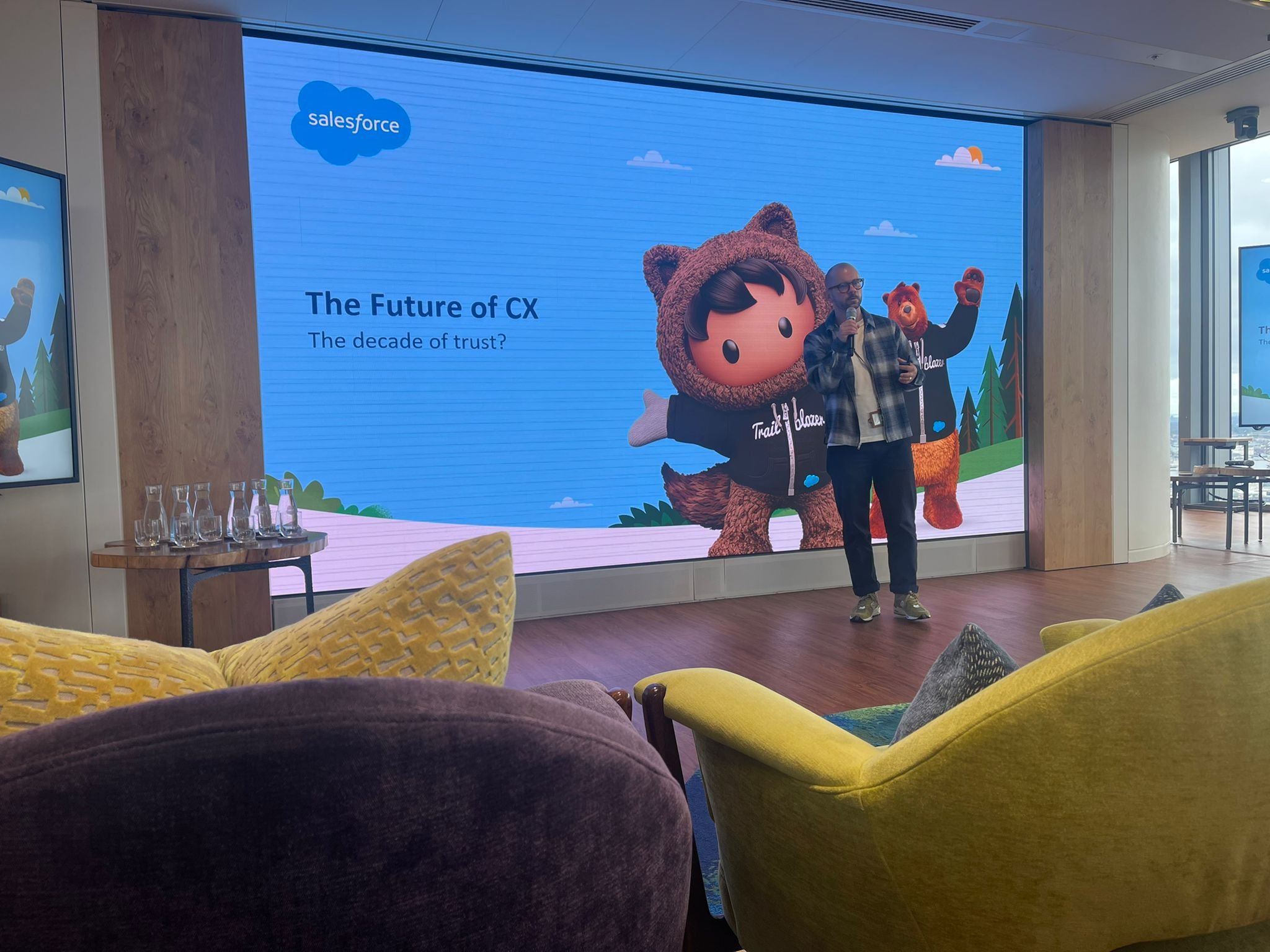
Chris talked about how you really need to focus on your problem statement, and to obsess over the problem. He also talked about knowing when it’s too late or too soon to start a project and making sure you simplify the process but to be sharp about what problems you are trying to solve, not what is trendy, because it’s likely what is winning today won’t be what is winning 5 years from now.
We then moved our focus onto XR and who would have thought that VR headsets making a comeback!
When I think about VR headsets it makes me feel a little seasick, and makes me question, ‘are they really making a comeback?’
Look at the likes of the company Accenture who recently purchased 60 thousand headsets for feedback practice and health and wellbeing programmes… then maybe they are? It made me stop and think, ‘should we be considering whether our customers favour an emotional reaction and immersive experience?’ With the likes of Apple potentially getting onboard with the future of headsets, we may start to find them in most homes once again.
We tapped into Web 3 and how it will put the power of ownership back into the hands of the user. ‘Would there be an appetite for memberships and loyalty schemes?’ Web 3.0 is the next major jump in how we consume and share information online, Search engines with AI capabilities are on the horizon which could affect user behaviour. In this new generation of the Web, the user's experience will be tailored to their wants and needs.
IoT is always a big subject but is quite easy to overlook the term, as it’s been around for so long. One thing that is always very clear with IoT, is you need an Internal skillset to be able to deliver IoT strategy to its fullest potential.
Did you know? A staggering 30 billion IoT devices are thought to be connected to the internet, which is an increase of 1490% in the last 20 years. From those 30 billion devices, 2.5 Quintillion bytes of data are collected but only 1% of data is actually used. I think the question here is, ‘what are we actually measuring, and can we be doing more with the data we collect?’
Customers can be weary of faceless tech, and when we talk about IoT strategies, we mainly focus on the products, which I feel can be counterproductive. What we should be more focussed on is the human experience and what matters most to our end user, including things like sustainability.
You need to get down to the nitty gritty of the user’s needs and what is the problem statement we are trying to solve?
“Data drives Innovation not limits it!”
Look out for part two coming on Thursday!
@Katie